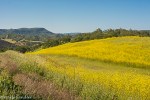
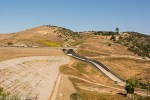
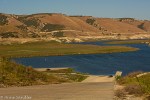
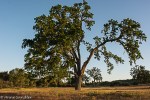
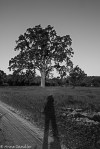
Mustard! It’s yellow just like the condiment, but you don’t spread it on sandwiches or hot dogs. You just look at its beauty and admire it. I’m amazed at how wildflowers can make a hillside or valley look stunning. You’ll see mustard in this post; the last of our visit to Lake San Antonio.
It was sad to see Lake Nacimiento and San Antonio so low in water capacity. We used to camp there with our children when we had a boat. We saw Nacimiento from Lakeside Rd and drove down to San Antonio. The California drought is becoming very noticeable now. We are beginning strict water rationing, which I think should have been done sooner.
Right now there are thunder storms north of us and it may be snowing in the Sierras. But, that won’t be enough to get us through the hot summer. I know the east coast has had enough rain and snow. Funny how Mother Nature is!
So, let’s get on with the serving of mustard–no hot dogs on the side!
Fields of mustard at this ranch.
Another view taken along Lakeside Rd.
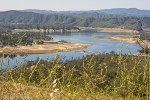
This is a finger of Lake Nacimiento.
You can see how far down the lake is.
We stopped to get gas and saw this old car.
This is beautiful, not like some of the old cars I shoot.
The owner is proud of his car and didn’t mind me shooting it.
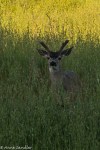
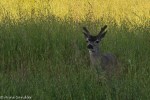
We saw this young buck along the roadside.
We stopped and I shot it out the truck window at 55 mm.
This is a spillover for Lake Nacimiento. No water to spill over.
A bit more of the countryside.
Lake San Antonio. I was half way down the boat ramp.
Do you remember the mossy trees and mustard that I went all the way to Napa Valley to shoot? Well, I found the trees in our campground and the mustard in the countryside here at Lake San Antonio.
It’s amazing how much I’ve learned through photography, and I don’t mean learning the art. I’ve studied birds, flowers and trees! So during this trip I had the opportunity to educate my husband in the flora of the area. Sadly, because the lake is so low now, there wasn’t the opportunity to see many water fowl. There were plenty of turkey vultures though.
In addition, I became acquainted with the various stages of the dreaded fox tail from beautiful to mowed down so they stick in your socks and dogs paws. All weekend I picked fox tails from Gem’s hair, checked his ears and made sure he was tick free. The little guy was happy to be home.
In this post, I’ll give you the campground tour including the mossy trees. You’ll have to wait for the next post to see the mustard.
Mossy tree.
Another tree with moss.
I just liked this plant/tree.
Expressive and beautiful.
Tree and photographer.
Now I’m shooting ground cover with the macro.
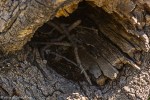
I also shot this log with the macro lens.
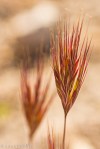
What’s better than one fox tail?
Two!
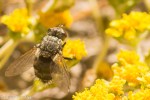
I saw this fly but didn’t have a swatter, so I shot it instead!
Some more of the yellow ground cover.
I don’t know what this is, but it was leaning just above the ground cover.
Mossy tree up close.
I think these are young fox tails.
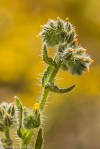
Again, I don’t know what this small plant is either, but I think the macro captured it well.
Have you ever chased windmills, you know the big white ones? Photo buddy Linda and I went out the day before a scheduled Meetup to catch the scenery, windmills, moonrise (which I didn’t get a good shot of) and sunset. Tall order for tall windmills!
We got to the area an hour later than the Meetup group was scheduled for the next day. Well, an admission, we didn’t get to the appointed area until we saw it on the way home. Typically when we meet with the Exploring Photography group, we enjoy a meal together and our organizer gives us directions and tips on where we should go to shoot. Not having these directions, we sort of got lost, but had a great time.
We stayed mostly on Montezuma Hills Road, stopping whenever we could after seeing something worth shooting. The area is farm country with windmills sitting in the pasture land. It’s not unusual to see windmills among the cows and farms.
I can’t say that the images I’m going to show you are my best, but they were the best I could do without an ND filter system. I wanted to get those giant windmills in slow shudder, but the sun was too bright. And by the time we got back from dinner, we almost missed the sunset. By the time we were on our way home, we were tired and thoroughly enjoyed chasing the windmills.
Sheep graze at this farm that is the object of the next six images.
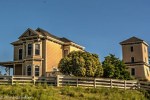
A wide view of this nice house.
Getting closer, you can see more detail.
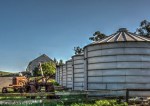
Across the driveway are the silos, barn and old tractor.
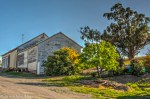
The barn.
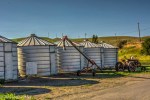
Another view of the silos.
A close up of the silos and tractor.
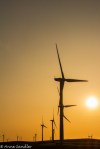
Here are those big windmills.
A closer look. The only thing I could do was to stop action.
Here they are on a pasture.
The sun is beginning to set.
It’s getting lower in the sky.
A closer view.
Someone tell this cow it’s time to go home!
The sun is behind the horizon. I can now get some slow movement in the windmills.
My old friend in this case is my 18 – 55 mm lens. It is my utility lens. Every time I promise myself to shoot with the prime 50 for the day, I usually pick up the 18 – 55. It is so nice that I rarely use my ultra wide lens when I have to carry the gear all day. I can do landscape and close up with this lens.
During our Ironstone Winery visit, I used my D7100 and the macro and 18 – 55 lenses. I will say that I look impressive with my sling (that sometimes carries two cameras) and vest. I’m pushing to live up to the image! In this post, you will see the grounds where they hold life cycle events and underground wine storage facility they call the cavern.
So here’s to my old friend, my 18 – 55! And here are the images.
This old truck and cart greet you as you come in from the parking lot.
A stream.
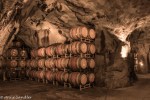
This will give you a better view of the cavern.
A close up view of the wine barrels in the cavern.
A lake view.
Sculptured grounds with the lake behind it.
They hold wedings, and more here at lakeside.
A little stream and bridge.
This old music player was placed before a mirror and made a nice reflection.
The banquet hall where they hold concerts, dinners, and cooking classes. There is a pipe organ in the auditorium side of the big room.
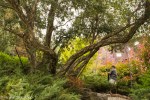
You know how I love expressive trees. This one just adds to the beauty.
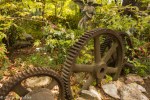
Some old gears put to good use.
This tree framed Charlie so well.
This is one of the winery’s cats.
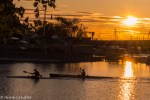
At the end of the day, we decided to stop at Lake Natoma to catch the sunset.
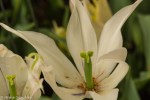
They say that “Practice makes perfect.” Well, in this case, practice made good! The practice was with the macro at the Ironstone Winery in Murphys. The grounds were full of tulips. daffodils and other flowers I can’t name. They were mostly in wine barrels so they could be changed out at will. My macro and I had a great time.
They also had a lake, beautiful landscaping and an amphitheater that was being remodeled. I came home with so many images, it took quite a while to go through them and edit. In this post, I’ll show you my macro work–since I’m bragging. Hey getting to good is better than where I was! I’m not captioning these images since I can only ID the tulips and daffodils.
In my next post, I’ll show you the grounds not shot with the macro.
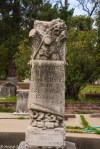
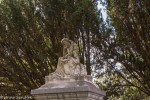
Is it wierd to keep going back to a cemetery just to shoot photos? This cemetery draws me back, and back. It’s large enough that your get shoot it all in one visit, and, for me, I seem to focus on different things all the time. This time it was the statues. They are beautiful, and are non-existent in today’s graveyards. They express the sadness of loss and hope for an afterlife.
This time I also found some masoleums worth shooting, some small grave stones and flowers. History is in this cemetery, so I guess I’ll keep going back until I’ve shot it all!
This statue got to me. You can sence the sadness. There is another similar one in this gallery.
Another one where you would suspect that a child was lost.
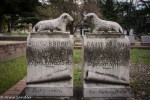
Here they are showing the loss of a loved one holding his pet.
This one made to look like a tree stump belongs to a woodsman.
Here’s the other statue that is similar to the first.
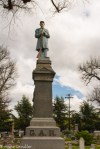
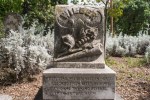
This one is dedicated to all veterans.
The grounds are just beginning to bloom.
Here’s the burial plot of a family. The large head stone belongs to the Patriarch .
Some of the many flowers.
The flowers make the grave stones beautiful.
Parents are buried here. The father has the larger stone. Would we do that today?
Here a family lost two sons. I’m hoping you can read the inscriptions on each.
Sometimes what is written says more than the stone’s design.
You know we use our dogs as an excuse or motivator to exercise. They know it and pretend they want to go for a walk. There’s the reality: they walk us! It was on such a walk that I received a surprise.
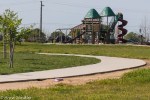
I had agreed to walk with Richard and Gem at their new place, Dry Creek Park. They have a new playground and sort of trail. When I go to Dry Creek, I walk along the creek with my camera to practice. This time I knew we weren’t going to the creek, but I need a shot for my 365 challenge so I brought my camera.
Now you’re probably wondering what the surprise was…wildflowers! My dog had this all planned out! So enjoy the walk that Gem took us on!
Old, quaint, touristy, and surviving are just some words to describe Sutter Creek in the California gold country and Amador County wine area. I say surviving because you used to have to go through the town as you drove highway 49. Now there’s a bypass so drivers don’t get bogged down in the town’s traffic.
From the town’s website: A wonderful balance of old and new, today’s Sutter Creek maintains its Gold Rush facade while catering to the wants and needs of visitors from around the world.Shop, dine, slumber, stroll, wine taste, and enjoy the quaint atmosphere of Amador County. Sutter Creek, the jewel of Amador County & the Gold Country, is steeped in history being born of the California Gold Rush and nurtured by the deep rock gold mines of the 19th & 20th centuries.
I wasn’t as impressed with Sutter Creek as I was by Downieville. But then, we were able to buy lunch in this town! Sutter Creek was more commercial, not catering to any season. But it is surviving.
Here are some images.
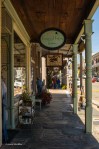
Looking down the main sidewalk.
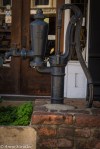
An old pump outside a store.
Now what is Kokopelli doing in Sutter Creek?
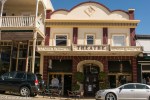
I liked this building and caught it in between cars.
The side of this building seems to have been painted over many times.
Another building I liked.
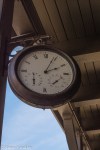
This is the first clock I’ve seen on a street that had the correct time.
Wow, I’ve been busy in the present time! I was testing and bought a used macro lens, and I’m looking forward to learning more about macro shooting. However, this post is about Downieville, a historic town. at the confluence of the Downie River and North Fork of the Yuba River. In my last post, I showed you images of the trip up and back, saving the town for today.
Downieville was founded in late 1849 and named after Major William Downie who founded the town. The town soon became a bustling gold rush town and is the county seat of Sierra County. Today it attracts summer tourists with fishing, mountain biking, back country off-road adventures, motorcycling, kayaking, and gold panning.
Of course, we were not there in the “season,” and no restaurant was open! But, the hardware, beauty shop and a few other stores were open. Enjoy the town. Maybe in the future I’ll have some macro images to show you!
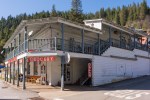
The North Fork of the Yuba River is right behind this Inn.
The grocery store.
This person sat on this bench the entire time we were in Downieville.
We were hoping to find food here, but it was closed.
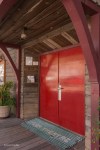
I wonder what’s behind the red doors.
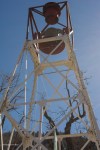
This bell tower was outside the grocery store in a parking lot.
The hardware store.
Still selling fishing tackle.
One of the closed restaurants.
This sign was on its door!
This old cash register was outside the steakhouse.
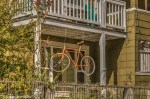
A house near the edge of town.
I liked the way they stored the bike.
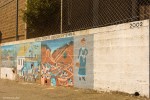
An unfinished mural.
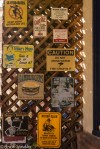
I can’t remember which building this was attached to, but it had cute signs.
It was an adventure back in time. With a population of 282 (the 2010 census) Downieville, the former gold rush town, now caters to summer visitors. However, photo buddies Marlene and Greg, and I were there last week. I can believe that they are a seasonal vacation spot because all the restaurants were closed and set to reopen for the season. I still don’t have any idea when the season starts!
Fortunately, the grocery store was open, had a microwave and allowed me to use it after I purchased a frozen rice dish. The small town hospitality came through. Sure I could have a glass of ice with my bottled diet coke–no extra charge for the cup! As we shot photos on the main drag, people passing knew each other. One of the residents explained that when they want to dine out, they go to the nearest town. It’s a simple life.
I’ll show you pictures of Downieville and give you more history in my next post. In this post, I’ll show you the sights on our way to the town and on the way back. You’ll be transported back in time along the North Fork of the Yuba River.
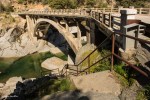
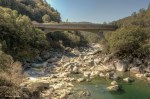
We stopped at this bridge along the North Fork of the Yuba River.
The Yuba River makes its way over rocks.
You can see the effects of the drought.
Even though the water is low, it is still beautiful.
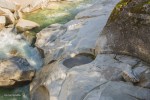
I wanted to capture this hole.
The small falls near the bridge.
The old Oregon Creek covered bridge.
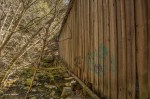
This bridge is not used any longer and probably won’t be repaired.
Another look inside.
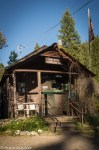
On our way home we stopped at this Post Office. It was closed, but operational.
Is your Post Office a cabin?
Does it have a portch where you can sit.
I just liked this old barrel.
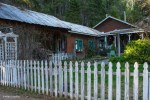
A house near the Post Office.
An old truck we found in the brush.
This truck probably hasn’t been moved in a long time.