How long does it take three photographers to walk a flat one mile loop through the Redwood Trail at Big Basin Redwoods State Park in Santa Cruz County, California? Answer: Almost four hours!
No excuses! It was a beautiful trail through a forest of expressive trees, and there was a lot for me, Marlene and Nicci to shoot.
Coastal redwoods (different from its relative the Sequoia) are found from southern Oregon to central California. Needing the coast weather they extend no more than fifty miles inland. These trees can reach 115 m (377 ft) tall. The bark can be very thick, up to 1-foot , and is soft and fibrous. When freshly exposed there is a bright red-brown color that gets darker as the tree is exposed to the elements. Its roots are shallow, wide-spreading and lateral. Redwoods are naturally resistant to insects, fungi, and fire because they are high in tannin and do not produce resin or pitch.
I remember when my children were young and we camped in a grove of coastal redwoods in Northern California. We went to a campfire program, but I left my flashlight at camp. I was good at walking by starlight, but the forest was so thick, we couldn’t see in front of us. Once I found a family who was walking back to the same campground, we followed them. I’ve never assumed that I could walk via moon and star lights again!
As for what lessons we learned:
- Always carry in your tripod. The forest is dark!
- Use a fast lens.
- Pack a lunch. Don’t count on a fast visit. Fortunately we brought snacks, and the cafe had a limited amount of lunch items.
Take a look at why it took us so long to walk that mile!

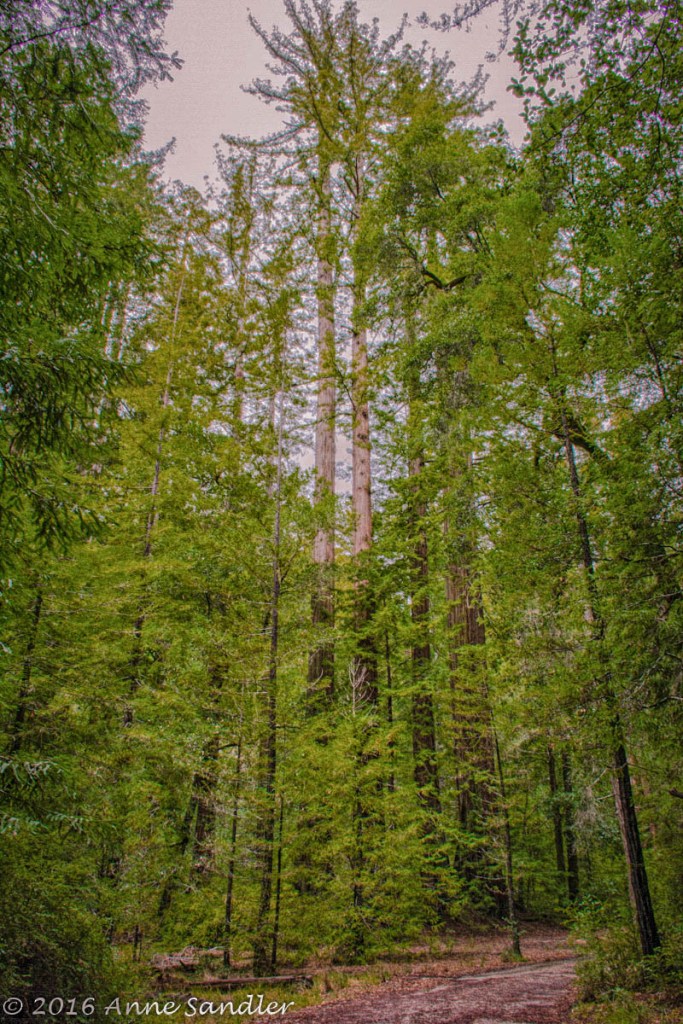
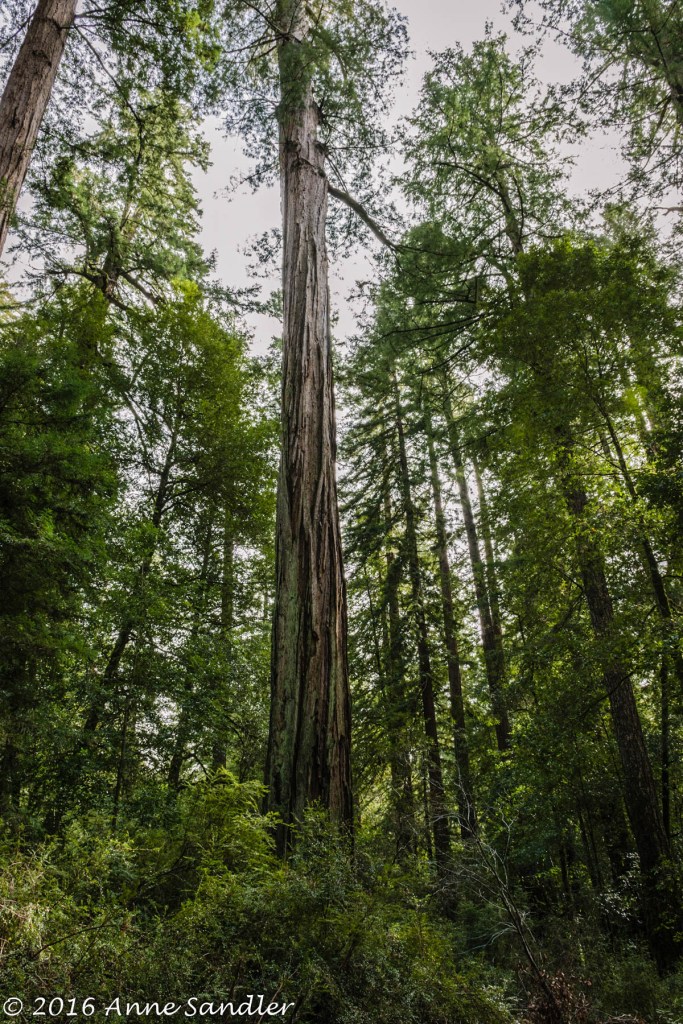
It was an overcast day. At the widest angle I had with me, I couldn’t get the entire tree in the shot!

A fallen tree’s root system. So beautiful.

A close look at the bark. You can see moss and lichen growing on it. There is also a burn spot.

The sun poked through the clouds.

Close up of a burl on a tree. Fungi and moss help create the colors.

Another downed tree. There was no way for me to get the entire tree in the shot.

The same downed tree. This part of the bark looked like feathers to me.

Some more lichen and moss living on the bark.

A burl on a stately tree.

I just wanted to throw in a black and white image.

Damaged by fire, this tree is still healthy. You can walk in and look up!

Just for a little perspective!

We weren’t the only visitors on the trail, but we took the longest time.

A fungi growing on the ground.

The path.

On our way out, we stopped and shot in the rain. No cameras were damaged.





 Slow Shutter Speed